
Europe's Heatwaves Alert: Impact of Rising Temperatures and Necessary Changes
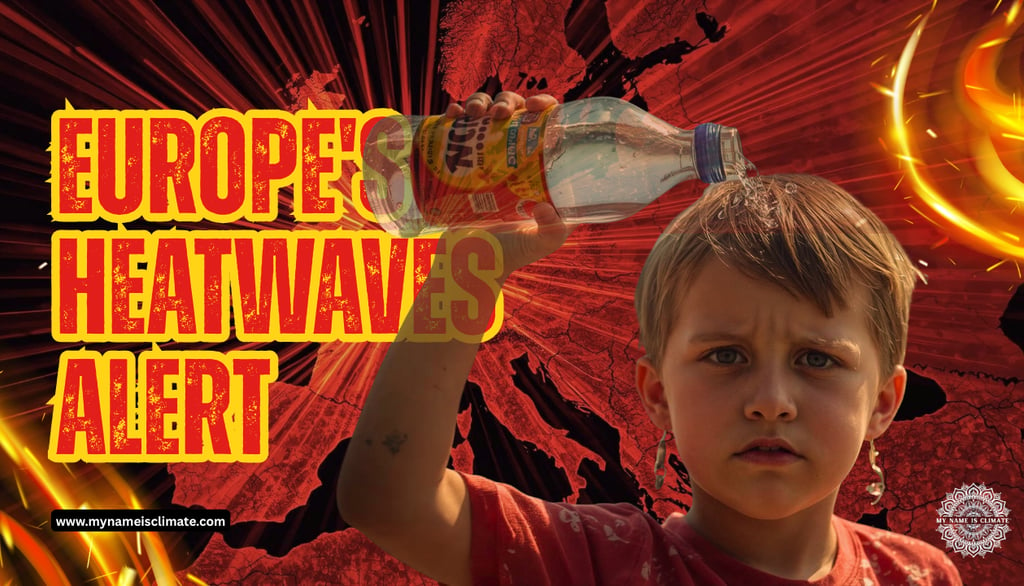
Europe is currently enduring one of its most severe and prolonged heatwaves in recorded history, with temperatures soaring past 45°C in parts of Spain and France and dozens of casualties already reported. This crisis has exposed a critical vulnerability: Europe, the world’s fastest-warming continent, is fundamentally unprepared for extreme heat.
CLIMATE ACTIONSUSTAINBLE FUTUREHEAT ALERT
Lalit Bhusal
6/25/20268 min read
For many from tropical and subtropical regions, a crucial question arises: why does the European sun feel so much more intense, and why is this heat so much deadlier compared to countries like India, Nepal, or other Asian nations where similar temperatures are common?
This article examines the scientific and structural reasons behind this phenomenon and, critically, explores what Europe must do to prepare for a hotter future—including why the Gulf region’s air-conditioning model is not a simple solution and what governments can do to protect their citizens.
The Current Situation: Europe Under a Heat Dome
Driven by a "heat dome" trapping hot air from North Africa, record-breaking temperatures have been reported across the continent:
- France: Temperature reached 44.3°C in Pissos, while Paris recorded 40.9°C—a June record
- Spain: 45.1°C in Andújar, with the Basque Country seeing 42°C
- UK: Recorded 36.1°C, with forecasts predicting 38°C
- Italy: 16 cities including Florence, Milan, and Rome are on the highest heat alert
- The Netherlands: Code Orange warnings remain in effect, with temperatures expected to reach 39–40°C
Health Impact: Each year, heat causes an estimated 175,000 deaths across Europe, according to the World Health Organization—a figure expected to rise sharply. During a single ten-day heatwave in June and July 2025, Milan, Barcelona, and 10 other European cities recorded 2,300 heat-related deaths, with more than half directly linked to climate change-driven heat.
Why Europe’s Heat Is More Lethal
1. The Humidity Factor Blocks Natural Cooling
When humidity is high, it becomes much harder for sweat to evaporate from our skin—the main way the human body loses heat. Unlike dry heat conditions where sweating effectively cools the body, high humidity creates a suffocating environment where the body cannot efficiently cool itself. This is why even temperatures that seem manageable can become deadly in Europe's humid conditions.
2. Buildings Trap Indoor Heat—and Europe Has Almost No Air Conditioning
This is perhaps the most critical structural vulnerability. European homes, traditionally built to retain winter warmth, become life-threatening heat traps during heatwaves. Only about 20% of European homes are equipped with air conditioning—compared to 76% in North America and 47% in the Asia-Pacific.
The deadly consequence: 98% of heat-related deaths can occur indoors, as tragically demonstrated during the 2021 heat dome in British Columbia, where 619 people died—98% of them inside their homes.
Expert warning: "The heat that truly harms people is the heat trapped inside their homes. On extremely hot nights, heat accumulates in the building structures day after day, worsening indoor conditions until the body simply cannot recover".
3. Lack of Nighttime Cooling—No Chance to Recover
The deadliest factor in this European heatwave is the lack of nighttime cooling, which prevents bodies from recovering from daytime heat stress. Urban heat islands—cities where concrete and asphalt absorb the sun's radiation and re-emit it at night—keep temperatures dangerously elevated throughout the night.
Hot nights compounded by hot days mean bodies never get a chance to recover. A study of 11 Southern European cities found that hot nights were strongly associated with increased mortality from cardiovascular and respiratory causes.
4. UV Radiation Intensity at European Latitudes
The European sun often feels stronger than in tropical regions, even at lower air temperatures. This is because at higher latitudes, a much greater proportion of UV radiation reaches the ground during summer. In locations like Paris or London, over 50% of daily UV comes during a shorter daylight period, meaning more intense radiation per hour of exposure.
Enhancing factors:
- Clearer, drier air—less atmospheric moisture and air pollution, which in tropical regions act as protective buffers
- Longer daylight hours in summer
- Lower aerosol particulates in Europe allow more sunlight to penetrate directly
Why Europe Can’t Simply Adopt the Dubai/ Arab Model
The instinctive comparison: if Dubai, Doha, and other Gulf cities can keep cool with massive air conditioning infrastructure, why can't Europe?
1. Buildings Are Not Designed for Cooling
Unlike the Middle East, where buildings are designed with cooling in mind—thick walls, small windows, and centralised AC systems—European buildings are designed to retain heat. Retrofitting millions of historic buildings with central AC is not only enormously expensive but often structurally impossible or restricted by heritage preservation laws.
2. The Grid Cannot Handle It—Yet
During the June and July 2025 heatwave, electricity demand in some parts of Europe spiked by as much as 14%, peaking above typical winter levels and contributing to outages in countries like Italy. In Germany, energy demand during heatwaves has risen more than fivefold since 1979. The European power grid is simply not built for the massive simultaneous load that full AC adoption would create.
3. The Climate Dilemma: Cooling Worsens Heating
Here is the cruel irony: air conditioning, if powered by fossil fuels, contributes directly to the climate change that drives the heatwaves. By 2050, cooling alone could generate 6.1 billion tons of carbon dioxide emissions globally each year—nearly one-fifth of global emissions under many scenarios.
The Gulf can rely on abundant, cheap energy. Europe cannot—and should not—solve its heat crisis by creating an even larger climate crisis.
4. Air Conditioning Is Inaccessible for the Vulnerable
Even where AC exists, the vulnerable populations who need it most—elderly people on fixed incomes, low-income communities, and those in substandard housing—are often the least able to afford installation and running costs. Solving heat through AC alone would deepen social inequality.
So What Must Europe Do? A Path Forward
Experts at the World Resources Institute, the UN Cool Coalition, and leading European cities have outlined a clear strategy: prioritise passive cooling first, use active cooling sparingly and efficiently, and protect the vulnerable.
The Four-Part Strategy
| Policy Area | Action | Intended Impact |
| Avoid the Need for Mechanical Cooling | Use passive design and vegetation for shading and ventilation | Reduce indoor heat, lower cooling demand, improve comfort naturally |
| Shift to Low-Energy Cooling | Use efficient fans or air coolers instead of conventional AC where possible | Provide cooling with significantly lower energy use |
| Improve Efficiency of Conventional Cooling | Upgrade equipment efficiency, adjust thermostat set points | Cut energy use, operational costs, and emissions |
| Protect Vulnerable Populations | Ensure safe, affordable cooling through policies and public services | Safeguard health, reduce heat-related mortality |
Source: Adapted from UN Cool Coalition/WRI
Passive Cooling Solutions That Work
Combining green urban infrastructure with energy efficiency measures can lower indoor temperatures by up to 2.9°C. This could reduce global demand for cooling by 24%, avoid $3 trillion in AC infrastructure costs, and cut 1.3 billion tons of CO₂ emissions.
Key passive solutions include:
- Green roofs and walls: Absorb heat, provide insulation, and create cooling
- Reflective surfaces and cool materials: Reduce heat absorption in streets and buildings
- Tree planting and urban greening: Provide shade and evaporative cooling
- Climate-smart building design: Improved ventilation, natural shading, and materials that store coolness
- Natural ventilation and wind corridors: Allow air flow to cool buildings naturally
Emerging solutions like hempcrete insulation—used in over 2,000 projects across Europe this year—can regulate indoor temperatures naturally while being carbon-negative. France's RE2020 regulation already encourages bio-based materials in new public buildings.
How Governments Can Help
Immediate Emergency Measures (Already Being Deployed)
European governments are already taking action, but these efforts must be scaled up:
Public Cooling Centres:
- Amsterdam has set up 12 "cooling points" in libraries, community centres, theatres, and even supermarkets, providing seating, drinking water, and toilets—many allowing pets
- Paris is offering free cinema tickets to young people (under 25) and seniors (over 65) to access air-conditioned venues
- Lyon has temporarily waived admission to public museums
- Rome, Florence, and Milan have established emergency cooling shelters after blackouts caused by surging AC demand
Work Schedule Adjustments:
- Several Italian regions (Lazio, Tuscany, Piedmont, Puglia, Liguria) have banned outdoor work from 12:30 PM to 4:00 PM on high-risk days
- Spain's 2024 law requires employers to adjust outdoor work safety during the hottest hours
- In Greece, Acropolis guards have secured schedule adjustments to avoid afternoon work
School and Transport Measures:
- France has closed 845 junior and middle schools, with 1,800 more adjusting schedules
- UK schools have shortened days, allowed PE kits instead of uniforms, and moved activities indoors
- Belgium has suspended older trains without air conditioning
- Rail speed restrictions are in place in France and the UK to prevent track deformation
Medium-Term Structural Changes
Building Renovation and Retrofitting:
- The EU's Energy Performance of Buildings Directive requires Member States to renovate their least efficient public buildings
- From 2030, all new buildings must be zero-emission buildings
- The Netherlands aims to build 30% of new homes with 30% bio-based materials by 2030
- Vienna has embedded heat resilience across its network of city plans, focusing on both mitigation and management
Urban Planning and Design:
- Create wind corridors to improve air flow
- Mandate green infrastructure in new developments
- Use cool construction materials and reflective surfaces in public spaces
- Map heat risks combined with social vulnerability data to target interventions equitably
- Cities like Barcelona, Vienna, Paris, and London have already mandated climate-resilient building retrofits, including green roofs
EU Policy Gaps That Must Be Addressed:
Currently, EU policies have focused heavily on expanding renewable energy supply and improving AC energy efficiency—but not on incentivising and mainstreaming passive cooling approaches. This must change.
What the EU and national governments should do:
1. Provide funding for passive cooling retrofits—currently, only a small share of the EU budget is dedicated to adaptation
2. Mandate heat-resilient building codes that prioritise passive cooling
3. Subsidise green roofs, cool materials, and urban greening in low-income neighbourhoods
4. Establish national heat action plans with clear responsibilities and dedicated staffing
5. Protect vulnerable populations through targeted public services, not just AC deployment
6. Enforce compliance with renovation requirements—infringement procedures are often slow and ineffective
The Role of Innovation
European cities are already innovating:
- Paris uses climate and vulnerability mapping to identify heat hotspots and guide interventions, creating "islands of freshness" in parks, libraries, and swimming pools
- Austria could cut future cooling demand by 68–73% through passive cooling measures alone
- Reggio Emilia uses digital twins to anticipate hydrological and heat stress
- Rotterdam combines green roofs and water squares for both cooling and stormwater management
The Bigger Picture: Climate Change Reality
This is not an isolated event. It is the new normal. Europe is warming twice as fast as the global average, and heatwaves in Europe are increasing three to four times faster than the rest of the midlatitude region.
Key facts:
- Heat-related deaths have soared around 30% in the last 20 years in Europe
- 2024 was Europe's warmest year on record
- Even with adaptation, heat-related deaths are expected to increase in nearly all regions
- One study projects an additional 2.3 million excess deaths in Europe by 2099 under the highest-warming scenarios
The WHO Regional Director has stated: "Heatwaves are no longer freak weather anomalies. They are now a recurring crisis". Nearly all heat-related deaths recorded in recent years were preventable.
Final Words from My Name Is Climate Foundation
This heatwave is a wake-up call. We are seeing the deadly consequences of climate change playing out in real-time across Europe. The fact that similar temperatures in Asia may feel different does not mean the risk is less—it means different regions face different vulnerabilities.
Europe's population is largely unprepared for extreme heat, with buildings, cities, and lifestyles built around moderate to cold temperatures. The Gulf model of mass air conditioning is not a realistic or sustainable solution—it would worsen the climate crisis, strain power grids, and deepen inequality.
What is needed is a fundamental transformation:
- Immediate emergency response: Cooling centres, work restrictions, public awareness
- Medium-term adaptation: Retrofit buildings, redesign cities, mandate passive cooling
- Long-term commitment: Reduce emissions, decarbonise energy, build resilience into every new development
Our appeal to everyone:
1. Protect yourself and your loved ones—follow safety guidelines
2. Check on the vulnerable—the elderly, the sick, the isolated
3. Support your community—share information and resources
4. Demand government action—passive cooling, building retrofits, and protections for the vulnerable
5. Take climate change seriously—support policies that reduce emissions
Let us face this crisis together. Let us be our brothers' and sisters' keepers. Let us survive this heatwave, but also let us learn from it and work together to prevent the worst from happening in the future.
Stay safe, stay hydrated, stay cool.
Data Sources: KNMI, RIVM, World Resources Institute, European Environment Agency, Copernicus Climate Change Service, WHO Europe, International Federation of Red Cross, University of Oxford, Cornell University, Covenant of Mayors, EUobseprver, and national meteorological agencies.

